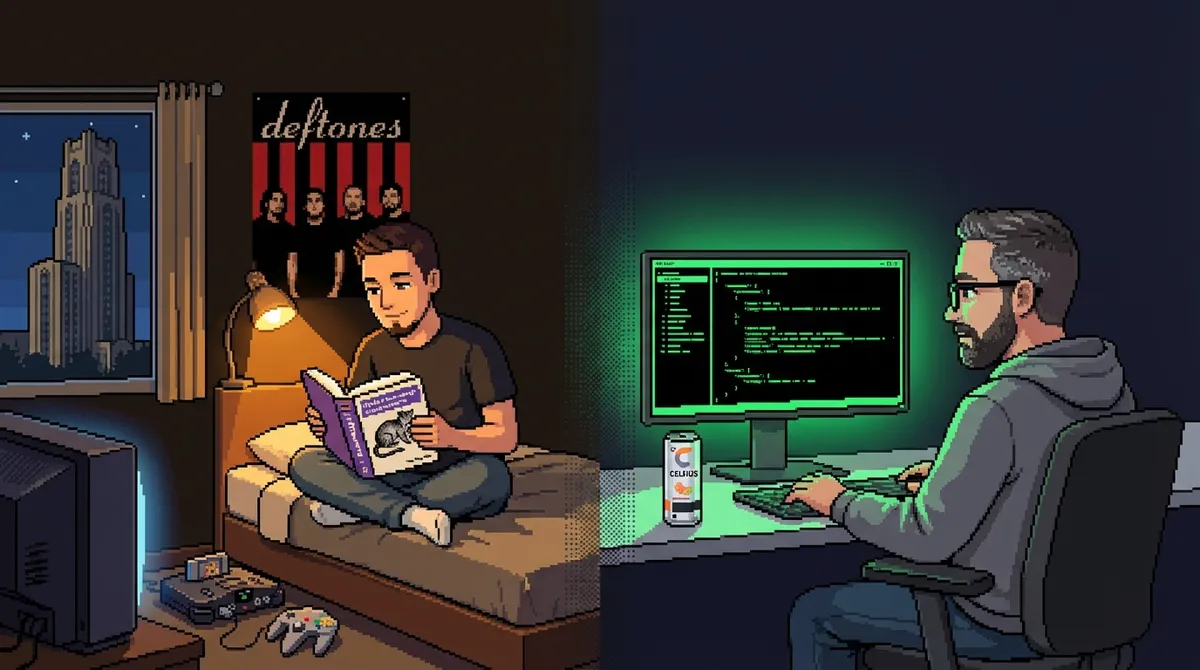
I have a confession. The images I use for these articles are… enhanced. Slightly. To flatter my physical appearance. Specifically, I’ve got some gray creeping in. Not full silver fox territory, but it’s there. The AI knows. The AI chooses not to show it.
I don’t consider myself “old”… but for the purposes of this article, I’ll wear that badge.
So, can an old dog learn new tricks?
The turning point
For a while, ChatGPT was just a slightly smarter Google. I’d ask it things I was too lazy to search for properly. It was useful, but it wasn’t changing anything.
Then I started using it to help my kids study. I’d snap a photo of their textbook or assignment, and ChatGPT would generate quiz questions from the content. Pretty slick, except the “quiz” was just me reading questions off my phone while they shouted answers. It worked, but it wasn’t exactly elegant.
Then I saw something about code generation. I don’t remember which release it was, but I thought, why not? I added an instruction to output the quiz as code. ChatGPT spit out a wall of HTML. I stared at it. I had no idea what to do with it. So I did what any self-respecting old dog would do: I Googled “how to put HTML on the internet.” Fifteen minutes later, I had a live quiz hosted on Netlify. My kids could pull it up on their phones. It was real. It was on the internet.
That was the moment. Not the HTML itself, but the realization that I could extend this interaction beyond the conversation. The output didn’t have to disappear when I closed the chat. It could become something that existed in the world.
I fell down the rabbit hole after that. Read everything I could find. Stumbled into Claude Code. A few weeks later, I found myself planning an app development session for a free Saturday like it was a home improvement project.
The app was my daughter’s idea. Sweet Signal, a simple tool to monitor Crumbl Cookie and Dairy Queen for new flavors. (Look, we take dessert seriously in this house.) That Saturday afternoon, my daughters (who had appointed themselves product managers) spent a few hours in the pool discussing requirements. Later, they grabbed the whiteboard from my old home office and sketched out two UI screens. I took a photo, loaded it into Claude Code, and we were off. A few weeks later, we had a working PWA they could access from their phones.
Development has slowed a bit since then. Turns out Crumbl has their own app with slightly better UI/UX. We got outcompeted. But that wasn’t the point. The point was that I went from “what do I do with this HTML” to building a working app with my kids. Since then, I’ve built a tool that turns any URL into a podcast episode I can listen to in Apple Podcasts (kind of a homemade NotebookLM). And I’ve got a little stock watcher running that I’ve put actual money behind. Not much. But enough that I’m trusting code I helped create.
Not bad for an old dog.
Here’s the thing. I’m not new to AI. I’ve been around NLP, machine learning. I understood the concepts. But there’s a difference between understanding the technology and seeing it turn into the delivery of actual work. That’s when it clicked. This isn’t a research project anymore. This is how things are going to get built.
That realization changed how I think about my team. We’re in the middle of an incredible transformation period in technology. I’ve been intentional about getting people exposure to these tools now, while there’s still room to experiment. Get the reps in during preseason so you’re ready when the game starts.
The ask
I’ll be honest. If you wait, it might be too late. I didn’t come up with that line, but it’s stuck with me because it’s true.
Here’s the thing. My software engineering education was in C++. I’ve never been paid a dollar to write C++, and that’s probably a good thing. But what I got from that degree wasn’t a programming language. It was learning how to learn. And if you’ve been in this field for any amount of time, you’ve done the same thing. You’ve picked up new stacks, new frameworks, new ways of thinking. You’ve reinvented yourself before.
You can do it again.
Pick a topic. You don’t need to understand all of this. Nobody does. Just pick one thing. Do a little bit every day. Read an article. Try a tool. Build something small. It snowballs faster than you’d expect.
This old dog learned some new tricks. Your turn.